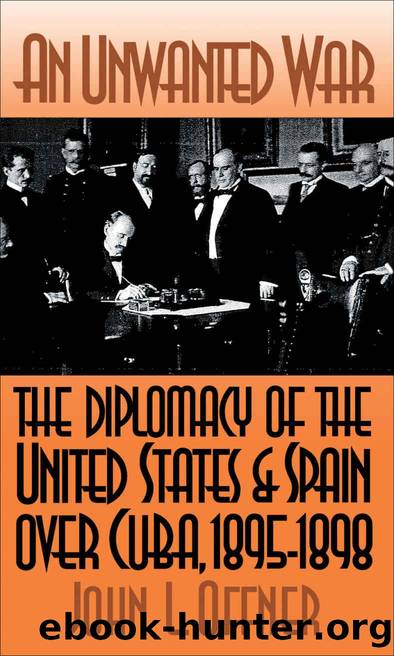
An Unwanted War: The Diplomacy of the United States and Spain Over Cuba, 1895-1898 by John L. Offner
Author:John L. Offner [Offner, John L.]
Language: eng
Format: epub
Publisher: The University of North Carolina Press
Published: 2014-04-24T06:00:00+00:00
Chapter 10
Spanish Suspension of Hostilities
War seemed inevitable when the European powers and the pope entered the crisis. In response to their efforts, McKinley postponed his message to Congress, and the Spanish authorized a suspension of hostilities. But the Cubans were not a part of these last-minute efforts, and the fundamental differences that divided the three protagonists remained.
Although the McKinley administration was committed to sending a Cuban message to Congress on 4 April, the deadline was extended two days. The pressure on McKinley decreased on 1 April when it was learned that the Spanish torpedo boats had gotten only as far as the Cape Verde Islands and were not yet ready to cross the Atlantic. Moreover, Day and John W Griggs, who had replaced McKenna as attorney general, needed time to draft the presidential message. The White House notified congressional leaders that it would delay the Cuban message until 6 April, which Congress accepted.
During the first week of April the Great Powers and Pope Leo XIII took a larger role in attempting to find a peaceful solution to the crisis. When the signs of American intervention had first appeared during the Cleveland administration, Spain had sought diplomatic support from the European powers. The European foreign offices had expressed varying degrees of sympathy, but until April 1898 they had rebuffed Spainâs repeated entreaties to enter the controversy. The European nations were divided and unwilling to antagonize the United States over Cuba.
Madrid found the greatest sympathy in Paris and Vienna. The French historically had a close association with Spain, shared a common border, and held much of the Spanish debt. They were also concerned about American expansionism; after Cuba, what would be Washingtonâs next target in the West Indies? In Austria-Hungary, the Hapsburg monarchy wanted the queen regent to retain her throne, and Vienna held a prominent position in Madrid through Ambassador Viktor Dubsky, who was the doyen of the diplomatic corps and on good terms with the queen regent. Austria-Hungary also felt freer to organize and lead a European coalition to support Spain because it had no New World possessions and little American commerce. But Vienna had little influence in Washington, and neither Austria-Hungary nor France was willing to act alone.
The other European powers were even more cautious. Great Britain, second only to France in importance to Spain, was pro-American. The Sagasta ministry watched England carefully not only because of extensive commercial relations but also because of its large Atlantic fleet, Gibraltar, North Africa, and Suez. Without British participation, the other European states refused to act, and London would do nothing unless the United States approved it in advance. Britain displayed such cordiality toward Washington that the Europeans suspected the existence of a secret Anglo-Saxon alliance.
The other European powers were more distant from the controversy. The German government chose a neutral policy even though the kaiser, Wilhelm II, was outspokenly pro-Spanish and friendly to the queen regent. The German chancellor and foreign minister, Prince Bernhard von BÃlow, was determined to keep on good terms with Washington.
Download
This site does not store any files on its server. We only index and link to content provided by other sites. Please contact the content providers to delete copyright contents if any and email us, we'll remove relevant links or contents immediately.
| Anthropology | Archaeology |
| Philosophy | Politics & Government |
| Social Sciences | Sociology |
| Women's Studies |
The Secret History by Donna Tartt(19365)
The Social Justice Warrior Handbook by Lisa De Pasquale(12262)
Thirteen Reasons Why by Jay Asher(9049)
This Is How You Lose Her by Junot Diaz(7002)
Weapons of Math Destruction by Cathy O'Neil(6404)
Zero to One by Peter Thiel(5897)
Beartown by Fredrik Backman(5874)
The Myth of the Strong Leader by Archie Brown(5579)
The Fire Next Time by James Baldwin(5541)
How Democracies Die by Steven Levitsky & Daniel Ziblatt(5294)
Promise Me, Dad by Joe Biden(5207)
Stone's Rules by Roger Stone(5151)
A Higher Loyalty: Truth, Lies, and Leadership by James Comey(5033)
100 Deadly Skills by Clint Emerson(4992)
Rise and Kill First by Ronen Bergman(4862)
Secrecy World by Jake Bernstein(4823)
The David Icke Guide to the Global Conspiracy (and how to end it) by David Icke(4792)
The Doomsday Machine by Daniel Ellsberg(4583)
The Farm by Tom Rob Smith(4574)
